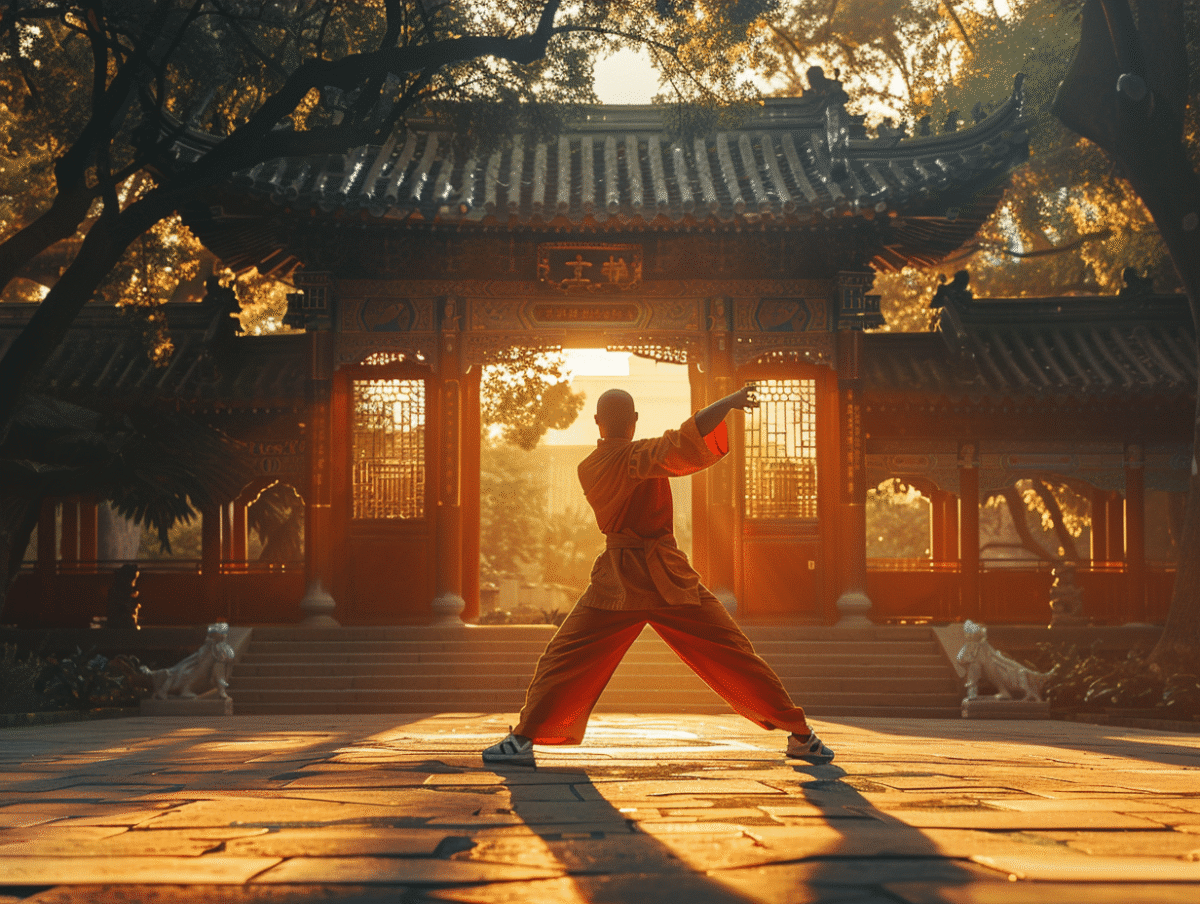
Chinese martial arts, with an ancestral history, have long been practiced in secrecy and discretion. In the past, these disciplines were the domain of monks and warriors seeking to perfect their combat skills and spiritual development. Over the centuries, they have gradually gained visibility, capturing the popular imagination around the world. This journey from obscurity to the spotlight has been catalyzed by cinema icons and international competitions that have paved the way for a global appreciation of the richness and diversity of these practices.
Chinese Martial Arts: A Historical and Cultural Journey
Wu Shu, this Chinese martial art of unfathomable depth, finds its roots in a centuries-old tradition, steeped in a rich and complex culture. Martial teaching, elevated to a true science of life and defense, has been passed down through the ages, thus shaping Chinese society. Practitioners of this art, initiated by great masters, have long cultivated a certain mystique around their techniques, often described as secret. The foundation of this teaching rests on fundamental principles and initial techniques, essential elements for understanding more advanced levels.
The transmission of the art revolves around mastering the three levels of Ta Cheng Chuan, each stage marking an evolution in the knowledge and application of Wu Shu. This progression is not only physical but also spiritual, as it engages the individual in a quest for personal improvement. The secret, although often associated with occult techniques, primarily lies in deepening these principles and fully realizing their potential.
In the same vein, Sanda, Chinese free fighting, illustrates the dynamic evolution of Chinese martial arts, combining striking, wrestling, and throwing techniques. This combat sport, incorporating elements from traditional Wu Shu, demonstrates the ability of these arts to reinvent themselves and adapt to contemporary contexts. The practice of Sanda, popularized both within the military and in civilian competitions, attests to the vitality and constant relevance of Wu Shu in the modern world.

Chinese Martial Arts Today: Practices, Influences, and Perspectives
The modernization of martial arts has not eroded the foundations of Wu Shu; quite the opposite. It has allowed for the adaptation of these ancestral disciplines to the contemporary world, where efficiency and pragmatism often dictate the rules. Techniques of visualization and mechanical principles now occupy a central place in training, reflecting a mutual enrichment between tradition and scientific innovations. These methods, far from betraying the original spirit, contribute to a sharper martial refinement, both technically and philosophically.
Wu Shu, while remaining true to its roots, also draws from advancements in the fields of neuroscience and biomechanics. Visualization, for example, is not just a mental fancy but a technique validated by research, allowing for a notable improvement in concentration and performance. This approach, where the mind precedes and guides movement, aligns perfectly with the principle of unity of body and mind, so dear to Wu Shu.
The assimilation of mechanical principles in the practice of Wu Shu reflects a desire to understand and apply physical laws to optimize movements. This scientific approach enriches the martial art by offering new perspectives on mastery, while remaining rooted in the quest for harmony and efficiency inherent to this discipline. Practitioners thus engage in a search for the right practice, which is nothing other than the pursuit of excellence through an ever-deepening understanding of their art.
These evolutions, far from distorting the essence of Wu Shu, place it in a dynamic of renewal and dialogue with its time. The practice, freeing itself from the constraints imposed by a too rigid view of tradition, opens up to new horizons. It invites an inner journey as much as an exploration of human capabilities, in the constant demand for self-overcoming. Wu Shu, while preserving its soul, adapts and reinvents itself, a testament to its vitality and relevance in the current century.