Comparing wedding trends from one season to another often amounts to reading decorative lists without concrete benchmarks. The real issue for couples preparing for their big day lies elsewhere: what choices truly impact the budget, the timeline, and the guest experience? This article confronts current wedding trends with the trade-offs they entail, backed by data.
Wedding Budget: What Surveys Really Measure
Average budget figures circulate abundantly in the wedding press. One rarely mentioned point: surveys do not all measure the same thing. The annual report from Mariages.net and the OpinionWay survey for Sofinco, for example, differ in the scope of expenses considered, particularly regarding the inclusion or exclusion of the honeymoon and the number of guests accounted for.
Presenting a single “average budget” as a reliable reference is therefore misleading. A couple planning their preparations should check the methodology of each source before calibrating their own spending categories.
To track these developments over the months, Mariage Conseils news regularly compiles data published by various industry players.
| Criteria | Survey type “married couples” | Survey type “intention” |
|---|---|---|
| Population surveyed | Couples who have already celebrated their wedding | People considering getting married |
| Budget scope | Actual expenses reported retrospectively | Forecasted estimates |
| Honeymoon included | Variable depending on the study | Often excluded |
| Average number of guests | Reported, often higher | Projected, sometimes underestimated |
This table is not intended to make a definitive judgment, but to show that comparing two average budgets without verifying their scope skews any analysis.
Number of Guests and Cost per Person: The Central Trade-off
The trend towards small weddings is not just about ambiance. It reflects a direct financial trade-off: reducing the guest list allows for an increased budget per person. Catering, drinks, guest gifts, reception furniture: each category varies proportionally to the number of attendees.
Couples who choose an intimate format (about thirty close friends and family instead of a hundred) can redirect the freed-up budget towards high-perceived-value items:
- A gourmet menu with wine pairings, where a large wedding often requires a standardized buffet
- A more elaborate floral decoration per table, with custom arrangements
- A high-end reception venue whose limited capacity naturally restricts the guest count
This logic also works in reverse. A couple who wants to gather their entire extended family knows that the cost per head will decrease, but the overall bill will increase. This trade-off should be addressed early in the planning process, as it influences the choice of venue, caterer, and date.
Weekday or Off-Season Weddings: Vendor Availability
Shifting a wedding from a Saturday in July to a Friday in September is often presented as a budget tip. The financial angle exists, but the main issue lies elsewhere: the actual availability of vendors in high season is the primary limiting factor.
Weddings remain heavily concentrated in a few months (May to September) and on Saturdays. This concentration creates pressure on reception venues, caterers, and service teams. A couple contacting a popular venue ten months before their desired date often discovers that summer Saturdays are already booked.
What a Weekday Wedding Changes
Choosing a Thursday or Friday does not automatically reduce the caterer’s or photographer’s fees. Some vendors apply a flat rate regardless of the date. However, the options expand significantly: more venues available, greater room to negotiate custom services, and a less constrained planning schedule.
The trade-off affects the guests. A weekday wedding requires attendees to take a day off, which can reduce attendance rates, especially for those who are geographically distant. The gap in vendor availability rarely compensates for a half drop in attendance.

Decoration Trends and Wedding Themes: Distinguishing Fashion from Coherence
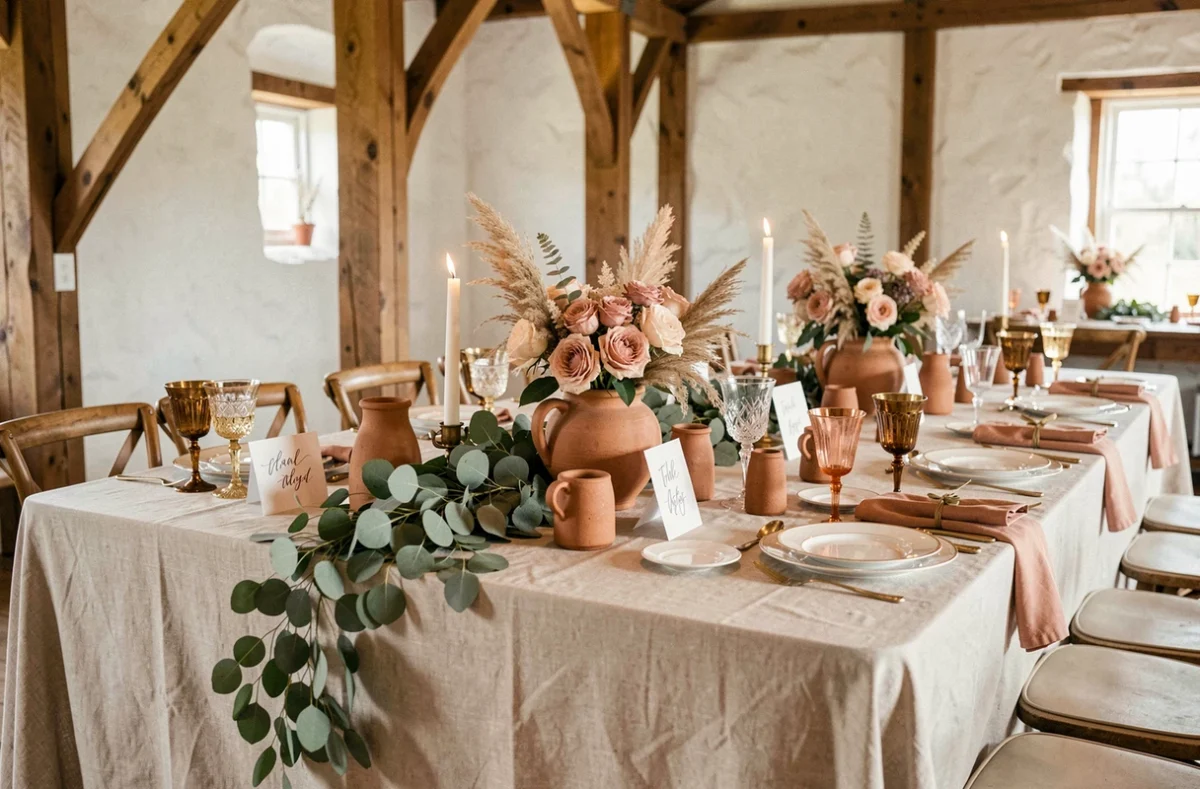
Quartz crystals on tables, muted color palettes, asymmetrical floral arches: decoration trends change every year. The trap for engaged couples is to pile up elements spotted on social media without a guiding thread.
An effective wedding theme is based on a simple principle: every visual element (colors, materials, typography of invitations, tableware) must serve the same intention. A couple drawn to a rustic ambiance does not need esoteric crystals on the tables, even if the trend exists.
- Define a theme in three words or fewer (for example: botanical, minimalist, bright) before choosing decoration vendors
- Check the coherence between the reception venue and the chosen theme, as a classic castle and bohemian decoration visually contradict each other
- Limit decorative elements to those that guests will actually notice (centerpieces, entrance decor, photobooth) rather than spreading the budget on invisible details
Wedding fashion evolves quickly. The decoration choices that age best are those that reflect the couple rather than a seasonal trend. The wedding photos, however, remain.
Administrative Procedures: The Real Calendar to Follow
Generic organizational advice sometimes masks a rigid constraint: the civil marriage file must be submitted at the town hall several weeks before the ceremony date. The timeframe varies by municipality, but the publication of the banns imposes a minimum non-negotiable period.
A couple who books their reception venue before checking the availability of the town hall on the desired date takes a concrete risk. Town halls in large cities often have limited slots available on Saturdays, with waiting lists during high season.
The civil ceremony remains the only legally recognized union in France. Any religious or secular ceremony is supplementary, never a replacement. This reminder may seem elementary, but planning forums show that confusion persists among some couples, particularly those organizing a wedding abroad.
The most underestimated administrative aspect in preparations is neither decoration nor catering: it is the legal calendar. Checking it first avoids the need to reorganize the entire schedule just weeks before the big day.