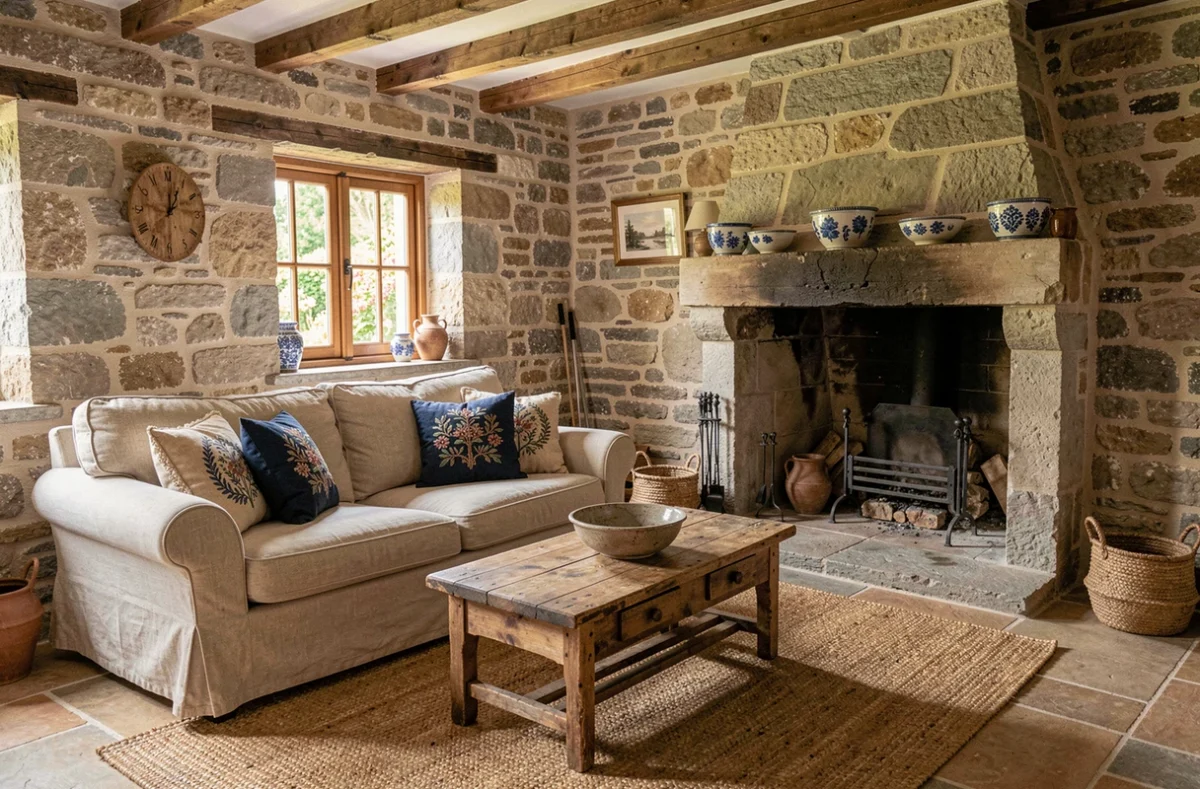
Brittany granite, lime plasters, and chestnut woodwork are not decorative accessories. They are technical materials whose hygroscopic behavior determines the comfort and durability of an interior. Decorating a house in the Breton spirit without understanding these constraints is akin to applying a decor to a structure that will ultimately reject it.
Breathable materials and humidity management in Breton decoration
A granite stone wall should not be treated like a concrete block wall. Applying a cement plaster or a waterproof acrylic paint on an old Breton structure blocks the migration of water vapor and causes issues: interstitial condensation, efflorescence, peeling of coatings.
We systematically recommend lime-hemp plasters on old walls. Lime allows the masonry to breathe while providing a mineral finish that naturally aligns with the Breton aesthetic. A troweled lime-sand plaster gives a raw, slightly irregular finish that captures the slanting light of coastal interiors.
For interior partitions, wood wool provides a coherent complement. It regulates ambient humidity and offers sound insulation that old longères require. A project documented by the community of municipalities of Pleyben-Châteaulin-Porzay combined lime-hemp plaster, wood wool in the roof, floor insulation, and humidity-controlled ventilation. This type of holistic approach helps preserve the old charm while achieving modern thermal comfort.
Anyone wishing to learn everything about Terre de Breizh house will find this logic of coherence between traditional materials and contemporary requirements applied to everyday objects and furniture.
Color palette of a Breton interior: beyond navy blue
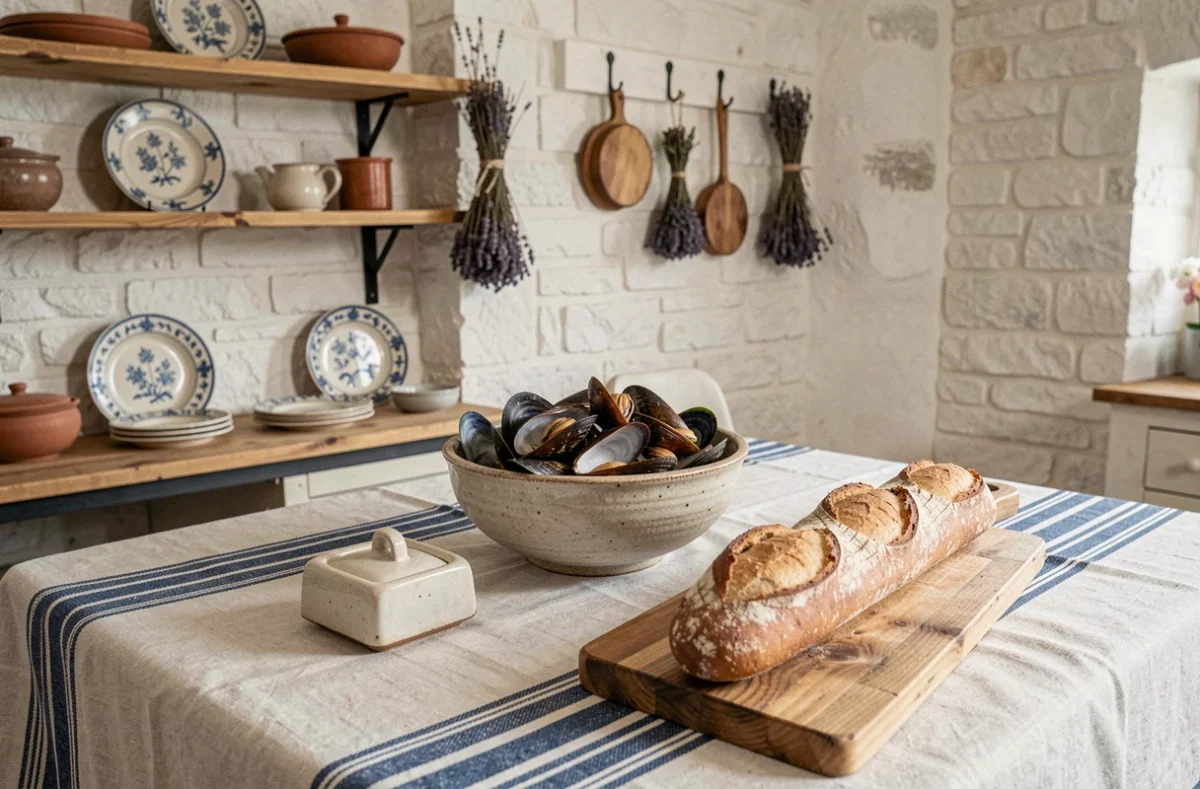
Reducing Breton decoration to blue and white is a misreading. The Atlantic palette starts from granite gray, not sky blue. The visual foundation of a Breton house rests on the warm grays of stone, earthy beiges of terracotta, and deep browns of chestnut wood.
Blue serves as an accent, not a dominant color. We observe that the most successful interiors limit blue to one or two strong elements (a window frame, a painted piece of furniture) and allow the raw materials to occupy the rest of the space.
Preferred associations room by room
- Living room: walls in stone-tone lime plaster, raw wood furniture (chestnut or oak), textiles in ecru linen. A cushion in Locronan fabric or a wool throw adds a regional touch without overloading
- Kitchen: terracotta tiles on the floor, artisanal earthenware as a backsplash (Quimper factories still produce hand-painted tiles), polished or brushed local granite countertops
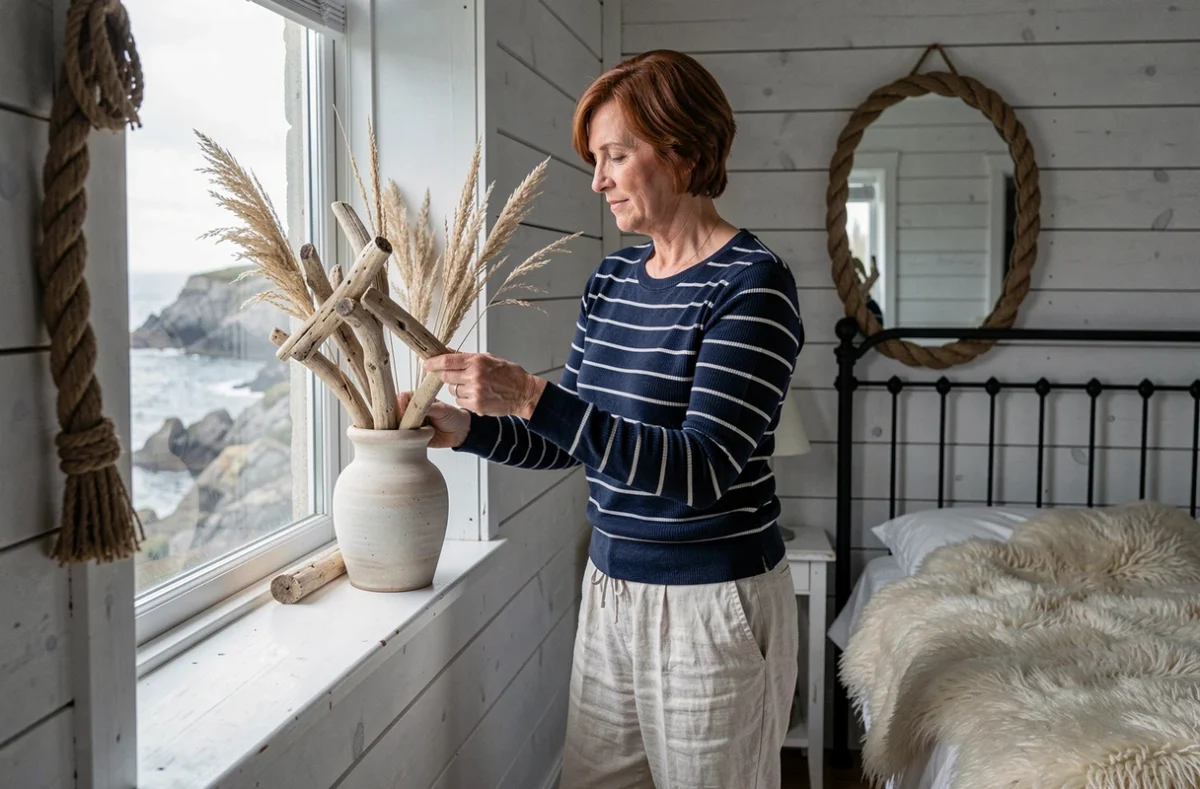
- Bedroom: natural chestnut parquet, headboard in driftwood or painted paneling in a muted blue-gray, bed linen in brushed cotton or washed linen
The common trap is to accumulate maritime objects (ropes, anchors, buoys) in every room. One strong object per room is enough to establish identity. The rest of the work is done through materials and colors, not symbols.
Reuse of Breton materials: a concrete decorative lever
Reuse is not just an ecological gesture. In decoration, it provides direct access to materials that are unavailable in new commerce: aged oak beams, slate tiles worn by a century of foot traffic, hand-forged ironwork.
In Hennebont, the RésoHabitat association collects and redistributes materials from social landlords, local authorities, businesses, and individuals. These materials feed into solidarity projects as well as private renovation projects. An old door recovered through this type of network has a thickness, grain, and hardware that industrial carpentry cannot replicate.
Integrating reuse without a flea market effect
The risk of poorly managed reuse is the “grandma’s attic” style. Each reused piece should be treated as a structural element, not as a trinket. An old beam becomes a fireplace lintel or a shelf support. A stack of reclaimed slates transforms into a coffee table top.
We recommend limiting reused elements to two or three per room and pairing them with contemporary furniture with simple lines. The contrast between old wood and a designer light fixture creates a visual tension that avoids pastiche.
DPE constraints and decoration: what changes for Breton houses
Since January 1, 2025, homes classified as G can no longer be offered for rent in mainland France. Homes classified as F will follow. This regulatory constraint directly modifies decorative choices in old Breton houses.
Insulating a granite wall from the inside reduces the living space and hides the stone. External insulation preserves the interior charm but transforms the facade. In both cases, the decorative project must be aligned with the energy project from the outset, not afterward.
A sufficiently thick lime-hemp plaster applied as internal thermal correction offers a compromise: it improves comfort without completely hiding the wall texture. The finish remains mineral and compatible with the Breton aesthetic. Combined with high-performance joinery and a wood stove, this setup allows for the preservation of a longère’s atmosphere while meeting regulatory requirements.
Authentic Breton decoration relies less on objects than on an understanding of the structure. Stone, wood, lime, linen: these materials dictate the palette, textures, and finishes. Respecting them is already decorating.