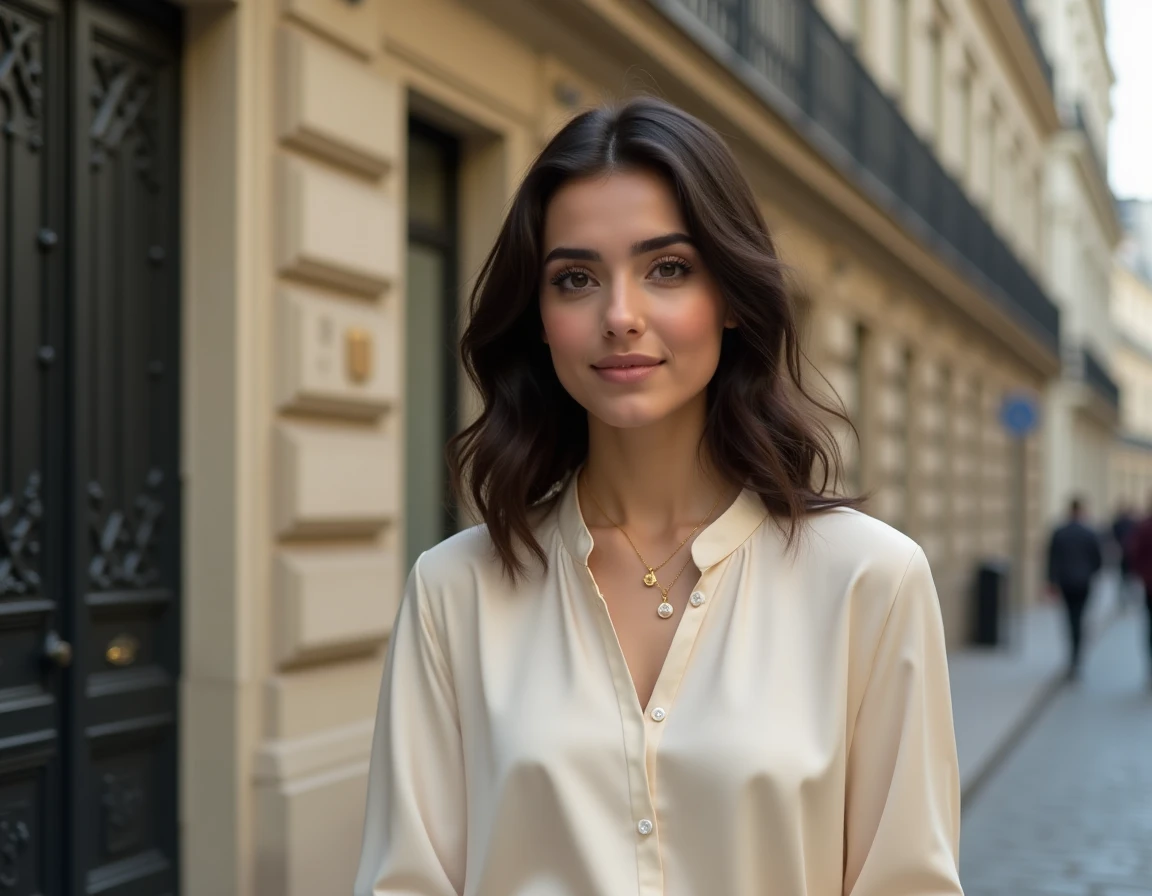
Betul Yilmazturk obtained the title of the most beautiful woman in France without going through the usual circuits of national beauty contests. This title, often repeated in the press and on social media, does not stem from an institutional competition like Miss France.
Legitimacy of the title of the most beautiful woman in France: what the election really entails
The title awarded to Betul Yilmazturk does not correspond to any contest regulated by an official French federation. There are no public regulations, no standardized national jury, and no recognized annual rankings by French cultural authorities that govern this designation. We observe that this title functions more as a media label than as a competitive distinction in the strict sense.
The profile of Betul Yilmazturk on the Belle et Naturelle website details the criteria used for this election and the reactions it has generated. This designation has propelled her name into the most popular searches related to beauty in France.

Betul Yilmazturk: an atypical profile in the French fashion landscape
What distinguishes Betul Yilmazturk from most media figures associated with beauty in France is the absence of a linear path in traditional modeling. No passage through historic Parisian agencies, no documented haute couture runway as a springboard. Her rise has been built through social media and digital visibility, a pattern that has become common but still marginal among personalities associated with a national beauty title.
Of Turkish origin, she claims an Eastern cultural heritage that colors her public image. This aspect is not anecdotal: in a country where beauty contests have long reflected very codified standards, the election of a woman with non-Western European origins has sparked discussions about the diversity of representations.
We note that verifiable biographical information remains limited. Existing articles focus on image and influence without providing a detailed professional timeline, documented training, or specific collaborations with identifiable brands. Betul Yilmazturk’s journey is more built on viral notoriety than on a classic professional portfolio.
Beauty criteria and public reception of Betul’s election
The election has reignited a recurring debate: are morphological criteria sufficient to define beauty? The grids used for this type of ranking measure proportions, not charisma, style, or presence.
- The lack of consideration for subjective criteria (elegance, expression, clothing style) in these rankings limits their scope as a comprehensive judgment of beauty.
The public reception has been polarized. On one side, massive support on social media, where Betul Yilmazturk’s face has circulated as a symbol of natural beauty. On the other, critical voices pointing out the promotional nature of such titles and the lack of transparency regarding the exact selection methodology.
Cultural heritage and Betul Yilmazturk’s influence on the perception of beauty in France
The election of a woman of Turkish origin has shaken up the usual representations associated with French beauty. Historically, media figures of beauty in France corresponded to very homogeneous profiles. The arrival of Betul Yilmazturk in this landscape coincided with a broader evolution of standards, driven by fashion, advertising, and digital platforms.
Her Eastern heritage, which she highlights in her communication, contributes to a movement of diversification of the faces associated with French elegance. This positioning is not solely aesthetic: it carries an identity dimension that resonates with a broad audience, particularly among women from the Turkish diaspora or more broadly Mediterranean.
We observe that her influence is measured more in digital visibility than in impact on the fashion industry. Documented collaborations with fashion houses or cosmetics brands remain rare in the available sources. Her role is more on the side of cultural influence: redefining, through her mere media presence, what the general public associates with the expression “beautiful woman of France.”
Betul Yilmazturk between modeling and cinema: poorly documented ambitions
Several sources mention an activity as a model and actress, without providing a filmography, identifiable advertising campaigns, or verifiable participation in professional events. This gray area is characteristic of profiles whose notoriety relies mainly on social media.
The absence of public professional milestones does not diminish the impact of her image, but it complicates any serious analysis of her journey. In the fashion industry, credibility is usually built through traceable collaborations, editorials in referenced magazines, or documented runway appearances.
The case of Betul Yilmazturk illustrates an underlying trend: notoriety linked to beauty is now built outside traditional circuits. Social media allows for reaching a considerable audience without going through the classic filters of the industry, which redefines the very notion of a career in this sector.
The title of the most beautiful woman in France awarded to Betul Yilmazturk remains more of a media object than a professional recognition in the traditional sense. Its significance lies in what it reveals about the ongoing transformations: French beauty is no longer defined by a single jury or a fixed standard, but by a collective, digital, and ongoing conversation.